Brandy, Relish Trays, and No Rush: Inside the Fight to Keep America's Supper Clubs Alive
There's a moment at a true supper club that newcomers always find a little disorienting: nobody's trying to turn your table.
You order a drink, and the bartender talks to you like you've known each other since high school. A relish tray arrives unbidden — raw carrots, celery, pickles, maybe some crackers and spread — and no one hands you a bill for it. The prime rib takes as long as it takes. Somewhere near the bar, a man in a fleece vest is on his third brandy Old Fashioned and his second hour of conversation.
This is not an accident. This is the whole point.
What Exactly Is a Supper Club?
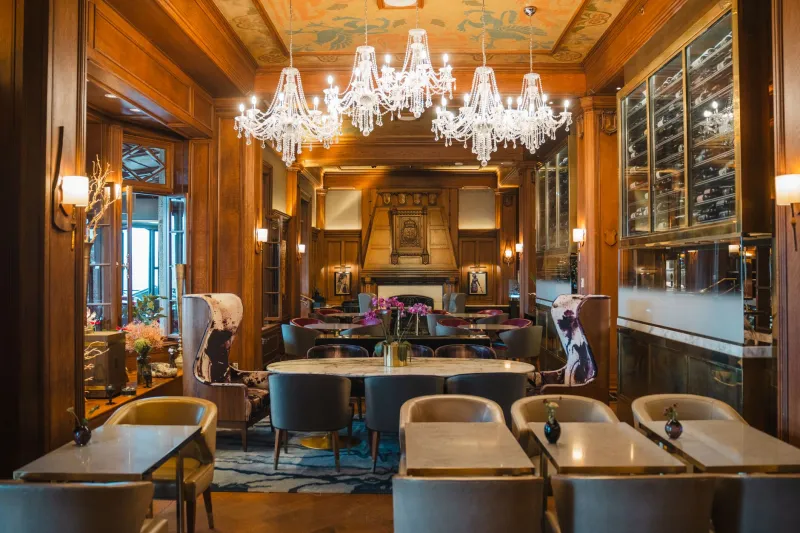
If you grew up outside the Upper Midwest, the term might sound like a book club with snacks. It's not. A supper club is a standalone restaurant — usually family-owned, usually decades old — that functions as a third place as much as an eatery. Think Wisconsin, Minnesota, northern Michigan, the Dakotas. Think wood paneling, a fireplace, a view of a frozen lake, and a menu that hasn't changed much since the Nixon administration because, frankly, it didn't need to.
The rituals are sacred. The relish tray is complimentary. The brandy Old Fashioned — brandy, not bourbon, thank you very much, muddled with sugar, bitters, and an orange slice — is the unofficial state drink of Wisconsin. Friday means fish fry: beer-battered perch or walleye, slaw, rye bread, tartar sauce by the ladleful. Saturday might be prime rib night, carved off a rolling cart and plated with a baked potato wrapped in foil.
And the pacing? Glacial, by design. Supper clubs were built around the idea that dinner is an event, not a transaction. You arrive at six for an eight o'clock table, and the drinks in the lounge aren't a delay — they're the first course.
Why They're Vanishing
Here's the uncomfortable math. Most supper clubs are small, family-run operations with thin margins and thick labor needs. When the owners hit their seventies, the kids who grew up busing tables have long since moved to Minneapolis or Chicago for jobs that come with 401(k)s. Selling to a chain doesn't work — chains don't want a 9,000-square-foot building on a two-lane highway. So the For Sale signs go up, and the buildings become or become vacant.
The pandemic accelerated everything. A business model built on lingering, crowds, and communal space doesn't survive well on carryout. Some beloved institutions — places where three generations of a town celebrated anniversaries, wake lunches, and post-prom dinners — simply never reopened.
There's also a cultural headwind. Fast-casual trained a generation to expect food in under ten minutes, ordered from a kiosk, eaten over a phone. The supper club's core product was never really the walleye. It was time. And time is the one thing the modern dining economy keeps trying to charge us extra to save.
Who's Saving Them
Here's the hopeful part: the obituary may be premature.
Across the Midwest, a wave of younger owners — many of them first-time restaurateurs, some of them immigrant families with deep food traditions of their own — have been buying these places and running them forward instead of letting them become memory.
Some keep the rituals intact out of reverence, changing almost nothing because the formula works. Others blend traditions in ways that feel less like a pivot and more like an honest reflection of who's cooking. Imagine a fish fry alongside a Hmong sausage special, or a relish tray that makes room for pickled vegetables with a Southeast Asian tang. The supper club format — generous, unhurried, community-owned — turns out to be a remarkably good vessel for new flavors. It's a big building with a loyal crowd and a bar that pours all night. That's a platform, not a museum.
In several lake towns, local regulars have gone as far as organizing fundraiser nights and GoFundMe campaigns when a beloved club faced closure — proof that people don't just dine at these places, they belong to them.
What Fast-Casual Could Learn
You don't have to mourn the past to admit the supper club got some things right that we've lost.
Hospitality as a default. The free relish tray isn't a loss leader; it's a welcome. When was the last time a restaurant gave you something before you paid for anything?
A drink worth sitting with. The brandy Old Fashioned is a two-hour cocktail. You can't shotgun it, and that's the design. It gives you a reason to stay put and talk.
Menus with a spine. A short menu, executed the same way for fifty years, builds trust. Nobody leaves a supper club disappointed that the walleye wasn't 'reimagined.'
Dinner as an evening, not a slot. The lounge-to-table rhythm — drinks, conversation, then a long meal — is basically slow food with a Wisconsin accent. It's the anti-QR-code.
Go While the Fires Are Lit
If there's one within driving distance of you — and if you're in the Upper Midwest, there almost certainly is — go on a Friday. Order the fish fry. Let the relish tray sit there while you decide. Get the brandy Old Fashioned even if you think you don't like brandy; you'll be wrong.
Then do the radical thing: don't rush. Order dessert. Talk to the people at the next table. Tip like the place matters, because the numbers say it might not be there forever.
The supper clubs that survive will be the ones we show up for. That part of the equation hasn't changed since the first wood paneling went up — and it never will.