Forty Dishes, One Country: How the Chinese-American Menu Became a Shared Language
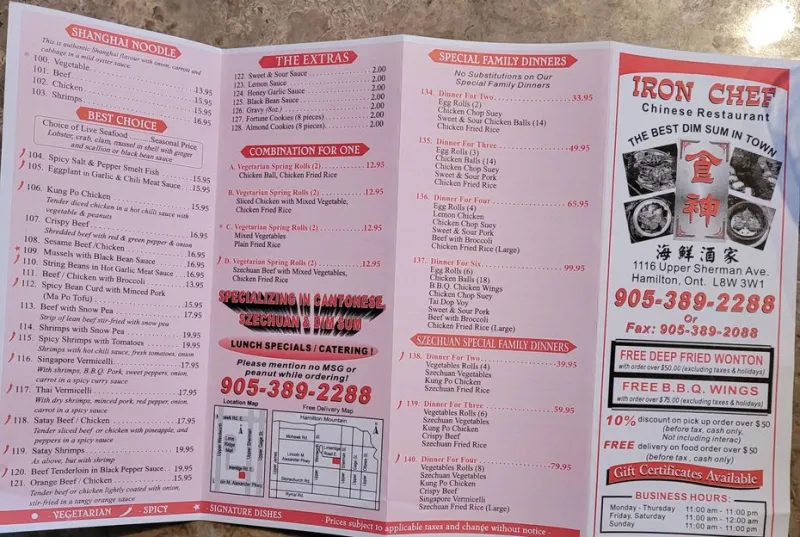
Photo: chinese restaurant takeout menu laminated counter, via static.wixstatic.com
Stand in the doorway of a Chinese restaurant in a strip mall outside Dayton, then fly two thousand miles and stand in the doorway of another one in suburban Phoenix. Same red vinyl booths. Same lucky cat by the register. And taped to the glass of the counter, the same laminated menu — General Tso's chicken, lo mein, egg rolls, the lunch special with fried rice and a choice of two items.
It's not a franchise. There's no corporate playbook. So why does every town in America seem to serve the exact same forty dishes?
The Menu That Built Itself
The standardization happened organically, dish by dish, over a century of immigration. Chinese restaurateurs arriving in the mid-1800s cooked for miners and railroad workers with whatever ingredients they could source — which meant substitutions. Celery instead of gai lan. Pork instead of char siu from a proper roast shop. Chopped suey wasn't a Chinese dish so much as an American negotiation.
By the postwar decades, a rough consensus had formed. Egg rolls. Sweet and sour pork. Fried rice. Chow mein. These were the dishes American customers knew how to order, and for a family running a restaurant on thin margins, teaching customers a new cuisine from scratch was a luxury nobody could afford.
"You have to feed your children," is how one owner in Ohio put it to me. "The menu is not a menu. It is a bridge."
Then, in the 1970s, a single dish supercharged the formula: General Tso's chicken. Invented or perfected — depending on who you ask — by Hunanese chefs in New York, it spread across the country like a rumor. Crispy, sweet, a little spicy, deep-fried. It was engineered, almost accidentally, for the American palate, and once it landed on one menu, customers demanded it everywhere else.
What the Owners Actually Think
I asked several restaurant owners which dishes they love and which they'd happily retire. The answers were more candid than you'd expect.
General Tso's is polarizing even among the people who make it. One second-generation owner told me she respects it the way a musician respects a one-hit wonder: "It pays the rent. I make it maybe two hundred times a week. Do I eat it? Never."
The egg roll inspires a different kind of fatigue. "People think it's easy," an owner in Georgia laughed. "Wrapping two thousand egg rolls a week by hand is not easy." Still, several admitted a soft spot for the ones straight out of the fryer, split open with a drizzle of hot mustard — the cook's snack, never on any menu.
And then there are the quiet favorites. Braised dishes with vinegar and white pepper. Salt-and-pepper shrimp that never made the laminated menu. Whole steamed fish with ginger and scallion, the kind of thing a family eats in the back after closing. "Americans order what they see," one owner told me. "So we cook what we want for ourselves."
The Secret Second Menu
Which brings us to the off-menu food — the real reason longtime regulars keep coming back.
Every established Chinese restaurant has one. It doesn't have a name and it isn't printed anywhere. It's activated by trust: a customer who's been coming for a decade, or someone who speaks a little Mandarin or Cantonese, or simply the person who asks, "What do you eat?"
Ask that question and the kitchen might produce a claypot rice with crispy bottom, or a bitter green stir-fried with garlic, or a soup with pork bone and mustard greens that's been simmering since morning. Some restaurants keep a hand-written sheet taped inside the kitchen door. Others just remember.
"The regulars find out," one owner said. "Word gets around the neighborhood. Then one day, five more people order the fish. That's how it spreads."
Standardization as Survival
It's easy to be a little snobby about the combo plate — to see the sameness as a watering-down. But talk to the people behind the counter and the story flips.
For most of the twentieth century, Chinese immigrants faced steep barriers to traditional employment: language, licensing, discrimination. Restaurants were one of the few paths open, and the standardized menu was the strategy that made thousands of independent family businesses possible. A cook could move from San Francisco to St. Louis and open a restaurant, because the menu — and the customers who understood it — would be waiting for him.
It's a distributed network with no headquarters. A folk franchise. And like the highway system or the diner coffee cup, it became part of American infrastructure: the guarantee that in any town, there's a place where you can get pork fried rice and a fortune cookie, and nobody will rush you out.
Read It Like a Local
Here's the move, next time you're standing at the counter: order the standard stuff — it's good, and it keeps the lights on. Then ask what the kitchen likes. Ask what they make for themselves. You'll either get a polite deflection or, if you're lucky and you come back a few times, an invitation into the other menu.
Forty dishes, one country. The laminated menu is the handshake. What comes after it is the friendship.