Folded Chairs and Foil Pans: Where Friendship Used to Live Before the Group Chat
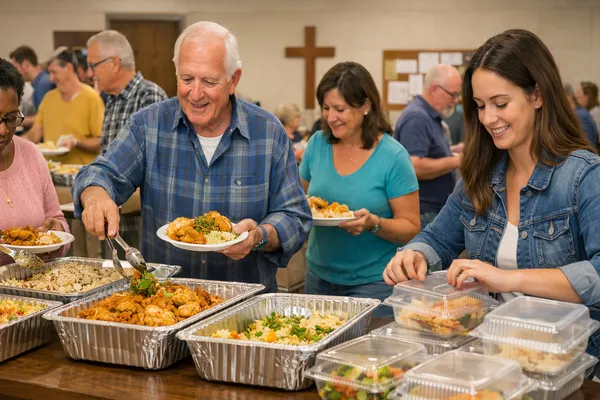
Photo: church basement potluck folding chairs casserole dishes community gathering, via cdn.shopify.com
My mother's church directory lived in a kitchen drawer for as long as I can remember, right next to the takeout menus and a roll of rubber bands. It was a thick spiral-bound book with grainy photos of every family in the congregation, and it was less a directory than a map of who owed whom a lasagna. New baby? Someone from page 34 was at your door with a chicken-rice bake. Hospital stay? The phone tree activated faster than any group text I've ever been part of.
I've been thinking about that drawer a lot lately, mostly because my neighborhood's most active social channel is a group chat where the top conversation thread this month was a dispute about a raccoon.
We're not short on connection, exactly. We're short on showing up.
The Institutions That Fed Us
Sociologists have a name for the places where Americans used to build their social lives — Robert Putnam famously wrote about bowling leagues in Bowling Alone — but the shorthand I prefer is simpler: the places with folding chairs. Church basements. Scout troop meetings in the school cafeteria. Rotary luncheons. The VFW hall on a Friday night.
And here's the thing that matters on a site like this one: almost all of them ran on food.
The bowling league didn't just bowl. It had a snack bar, a beer frame, and a standing post-game order of nachos that everybody knew without asking. Scout meetings meant parents lingering over coffee and store-brand cookies long after the kids had been herded outside. The neighborhood association's biggest draw was never the minutes — it was the potluck table.
Food was the mechanism, but belonging was the product.
What the Foil Pan Got Right
I called up a few people who spent decades inside these institutions — a retired church secretary in Ohio, a former league bowler in Wisconsin, a woman who ran her scout troop's annual chili cook-off for 22 years — and their answers kept circling the same few ideas.
1. Frequency beats intensity. The league met every Tuesday. Not when it was convenient. Not when the vibe was right. Every Tuesday, whether you felt like it or not, and that obligation is precisely what turned acquaintances into friends. Modern friendship asks, "When are you free next quarter?" The bowling league said, "See you Tuesday."
2. Someone has to cook. The foil pan is doing more work than it appears. Bringing food to someone is a physical act of care that a thumbs-up emoji cannot replicate. It says: I spent time and money on you, and I expect nothing back except an empty dish.
3. The table is more important than the talk. Nobody at a church potluck was having deep conversations every week. Most weeks it was weather and grandkids and someone's clogged gutter. But the depth came later, built on a foundation of shallow, repeated contact. We've got that backwards now — we skip the small talk and go straight to sharing our anxieties with people we've never sat across a table from.
4. Institutions give you a role. My scout-leader friend pointed out that everyone in her troop had a job, even if the job was "bring napkins." Roles create obligation, and obligation creates belonging. The group chat has no roles. Everybody's a lurker, and nobody brings napkins.
The Raccoon Chat Is Not the Enemy
I want to be fair here. The group chat is a miracle. It found my neighbor's lost dog in forty minutes. But it's a coordination tool, not a community. It gets people information; it rarely gets people casserole.
The good news is you don't need to found a bowling league or join a congregation to borrow what worked. A few low-effort moves, tested by people I know who've actually pulled them off:
- Start a standing thing, not a planned thing. "First Friday, my porch, bring a drink" requires no RSVPs and no negotiating. If someone can't come, the thing happens anyway. That's the whole secret of the league night.
- Assign the dish. When you invite people, tell them what to bring. It sounds bossy. It's actually a gift — nobody wants to figure out what to make, and a potluck where everyone's assigned something feels like an event instead of a chore.
- Keep the foil pan in circulation. When someone on your street has a baby, a surgery, a death in the family — don't text "let me know if you need anything." That's outsourcing the labor to the person with the least capacity. Send the soup. Text afterward: "dish on the porch, no need to answer."
- Learn one name per gathering. The church directory worked because everyone was, quite literally, in a book. Your version is simpler: leave every get-together knowing one more neighbor's name than you did before.
Bring Back the Folding Chairs
My mother still has that church directory, though it's been through three cover redesigns and one coffee spill. The families in it have changed, kids have grown and scattered, and the phone tree has, admittedly, become a group text. But the casserole circuit never stopped. Someone's still cooking. Someone's still showing up.
That's the part worth resurrecting — not the institutions themselves, necessarily, but the contract they represented: show up regularly, bring something edible, accept a small job, and don't wait for anyone to ask.
The raccoon chat can stay. But so should the foil pan.