The Dish You Have to Give Back: Remembering the Fine Art of Dropping By

Photo: Unknown, Public domain, via Wikimedia Commons
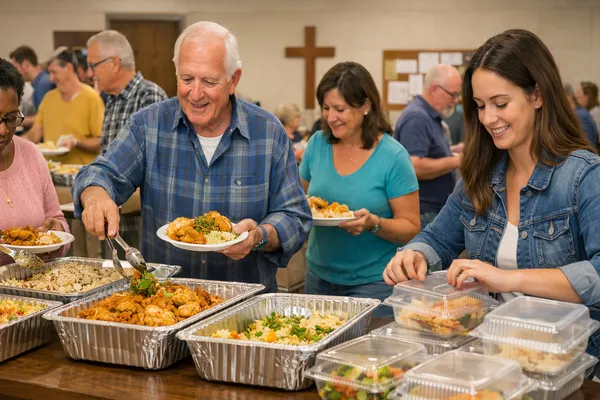
Somewhere between the doorbell camera and the 'omw' text, we lost something. We lost the knock that came without warning. The plate of brownies balanced on one hand. The Tupperware of soup from the neighbor who 'accidentally' made too much.
If you grew up in an American neighborhood before roughly 2005, you know exactly what I mean. Somebody's mom showed up with a foil pan of lasagna because she heard your uncle was in the hospital. Somebody left a paper sack of tomatoes on the porch railing with no note at all. And somewhere in your kitchen right now — be honest — there's a dish that belongs to someone else.
That dish is the whole point. Let me explain.
The Dish Is a Contract
The unspoken genius of porch-giving was never the food itself. It was the return trip.
When Mrs. Kowalski from next door handed you her Pyrex full of chicken and dumplings, she wasn't just feeding your family. She was scheduling a second interaction. You couldn't just rinse the dish and stick it in the cabinet. You had to bring it back — and everyone understood you didn't bring it back empty.
A returned dish was a conversation. Cookies if you had time, a jar of something if you didn't, and at minimum a ten-minute porch chat about the weather and whose kid was growing up too fast. The dish was a check that only conversation could cash. It was social engineering disguised as bakeware.
We don't have many systems like that anymore. Most of our interactions are opt-in, scheduled, and cancellable. The dish didn't care if you were busy. It sat on your counter, quietly insisting that you go next door.
The Unwritten Rules, As Best As Anyone Ever Wrote Them Down
Nobody published a handbook on porch etiquette, but the rules were ironclad anyway. For the record, and for anyone hoping to revive the practice, here they are:
Never arrive empty-handed, but never arrive fancy. A plate of cookies, a bag of sweet corn, an extra pound of burger from the butcher run — all acceptable. Anything that requires the host to immediately find plates and forks puts pressure on everyone. Porch food is food that travels well and asks nothing of the recipient.
Ring the bell, don't lurk. Yes, the whole point was the surprise. But you knocked. You didn't leave a casserole in the sun to congeal while the family was at work. If nobody answered, you left the goods in the shade with a note and took the dish back another day.
The seasonal surplus is sacred. August zucchini. September apples. End-of-garden green beans. These were not gifts you could refuse — refusing was practically an insult. You accepted the zucchini, and you accepted the three more zucchinis that followed.
The return must include something. This is the big one. Returning a dish empty was the social equivalent of replying 'k' to a heartfelt text. It didn't have to be much. It had to be something.
Don't keep score. Nobody tracked who owed whom. The whole economy ran on generosity with a vague, unspoken faith that it would come back around. It always did.
Why We Stopped Knocking
It's easy to blame our phones, and honestly, they deserve a lot of it. When you can text 'I'm outside' from the driveway, the surprise visit starts to feel rude instead of friendly. We've been trained to believe that showing up unannounced is a violation rather than a gift.
There's also the simple fact that we don't cook in quantities that produce leftovers to share. When dinner is a single-serve air fryer situation, there's no surplus casserole to pawn off on the neighbors. The porch economy requires surplus, and we've optimized our lives to have none.
And maybe, if we're being honest, there's a little fear in there too. A drop-by risks catching someone in their sweatpants, their mess, their bad day. Texting first protects everybody's dignity. But dignity is overrated when the payoff is a neighbor standing on your step holding a warm loaf of banana bread.
How to Bring It Back Without Being Weird About It
You can't just start ambushing people — the muscle has atrophied. But you can reintroduce the practice gently.
Start with the excuse. Made too much chili? Say so. Genuinely have too many tomatoes? Say that too. The excuse gives your neighbor permission to accept without owing you a long visit, and it gives you a graceful exit.
Use the porch as a first venue. You don't have to cross the threshold. Hand over the goods, chat for five minutes, leave. Short and sweet lowers the stakes for everyone and makes the next visit easier.
And when you get the dish back — because you will, if you give one — put something small in it. Then hand it back and watch what happens. The dish starts circulating. It becomes a kind of slow, ceramic currency, and before you know it, you know what your neighbor's kids are up to and which lawn service to avoid.
The Point Was Never the Food
Here's what I keep coming back to: the cookies were fine, the casserole was usually fine, but the food was almost beside the point. What the porch drop-by actually delivered was evidence. Evidence that somebody thought of you without being prompted. Evidence that you existed to somebody beyond a contact list.
We have more ways to reach each other than any generation in history, and somehow fewer reasons to actually show up. The borrowed dish solved that problem with nothing but ceramic, butter, and a little nerve.
So this week, make too much of something on purpose. Put it in a dish you like, one you'll be happy to see again. Knock on a door. And when the dish comes back — it will — make sure it doesn't come back empty.